A builder we work with near the Boyne nearly lost half his site to a slip after a wet winter. The slope looked fine in August. By February, the top metre was moving. That is why we do not guess with slopes in Navan. We run a full slope stability analysis before a machine turns soil. The geology here has surprises. Glacial till sits on limestone, and water finds its way into the layers. We model the ground with limit equilibrium methods and finite element analysis. You get a factor of safety number that planners and insurers accept. No delays. No arguments. Just a clear answer on whether your cut or embankment holds. We also cross-check critical sections with test pits to verify the stratigraphy we plug into the model.
A slope that stands today can fail tomorrow. The difference is a factor of safety backed by real soil data, not guesswork.
Methodology and scope
Core deliverables in every report: factor of safety for global and local failure, critical slip surface geometry, recommended slope angle, and drainage prescription. We reference Eurocode 7 (EN 1997-1:2004) Design Approach 1 throughout, which Irish planning authorities expect. Turnaround is typically ten working days from site investigation to final PDF.
Local considerations
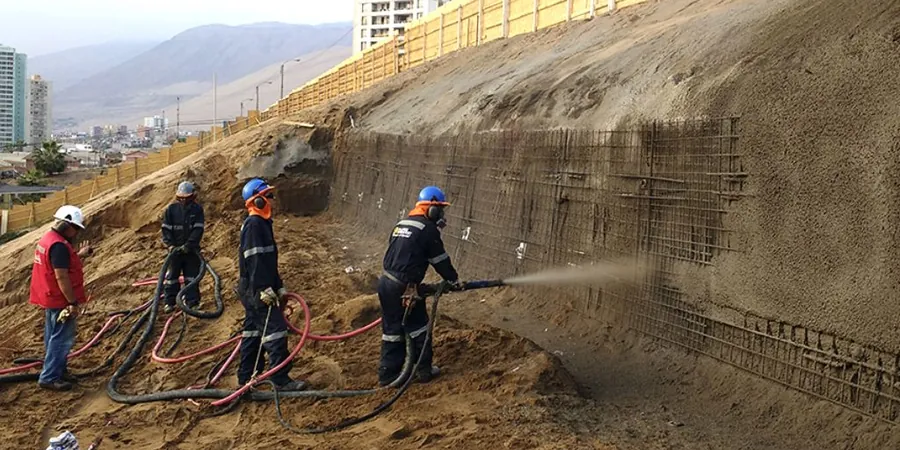
Navan sits at roughly 42 metres above sea level, with the Boyne and Blackwater cutting through the town. That river valley topography creates natural and man-made slopes everywhere, from the Trim Road embankments to housing estates backing onto the river. The Office of Public Works flood maps show pockets of high groundwater across the area. A slope failure in Navan is not a theoretical exercise. In 2015, heavy rainfall triggered multiple shallow landslides across County Meath, and insurers have tightened their requirements since. If you skip a proper slope analysis, you risk a planning refusal, a costly retaining wall retrofit, or a liability claim if your cut destabilises a neighbouring property. The cost of remediation always exceeds the cost of the analysis. We have seen quotes for emergency slope repair hit five times the original earthworks budget.
Applicable standards
Eurocode 7 (EN 1997-1:2004) – Geotechnical design, Irish National Annex to Eurocode 7 (I.S. EN 1997-1:2004/NA:2010), BS 5930:2015 – Code of practice for ground investigations
Associated technical services
Preliminary Slope Assessment
Desk study plus walkover survey for pre-planning. We review geological maps, LiDAR data, and site history. You get a qualitative risk rating and a scope for the full investigation. Suitable for site acquisition and feasibility stage.
Detailed Stability Analysis
Full geotechnical investigation with boreholes or trial pits, lab strength testing, and computational modelling in Slide2 or PLAXIS. We deliver a signed report with factor of safety, critical slip surface, and construction recommendations.
Remediation & Monitoring Design
For slopes that have already moved or show signs of distress. We design drainage measures, regrading profiles, or retaining structures. Includes inclinometer and piezometer monitoring plans to satisfy insurers.
Typical parameters
Frequently asked questions
How much does a slope stability analysis cost for a typical Navan site?
For a single residential plot with a modest cut or fill slope, you are looking at €1,280 to €2,500. That includes site investigation, lab testing, and the analysis report. For larger commercial or multi-slope sites, the range runs €2,800 to €4,330 depending on the number of sections modelled and the complexity of the ground conditions.
Do I need a slope stability analysis for a single house extension?
If the extension involves a cut deeper than 1.5 metres, or if the site slopes more than 1 in 10, most Navan planners will ask for a geotechnical statement. The analysis proves the excavation will not undermine your existing foundations or the neighbour's land. It is cheaper to do it upfront than to stop work mid-project.
What happens if the factor of safety comes back below the required value?
We do not just hand you a failing number and walk away. The report includes practical remediation options: flattening the slope, installing subsurface drainage, adding a toe berm, or designing a retaining element. We re-run the model with the proposed fix and confirm the new factor of safety meets Eurocode 7 requirements.
How long does the full analysis take from start to finish?
Site investigation takes one to two days on site. Lab testing runs five to seven working days. The modelling and report writing takes another three to five working days. A typical project goes from instruction to final report in ten to twelve working days. We can fast-track to seven days for an additional fee.