In Navan, the limestone bedrock isn't uniform. We've mapped karst features and variable drift thickness across the Boyne valley that directly affect ground motion amplification. A standard code spectrum won't capture that. Seismic microzonation bridges the gap—it gives you a site-specific ground response analysis instead of a generic one-size-fits-all approach. For engineers working on the new developments along the Ratholdren Road or near the town centre, this means designing for real local conditions. It's also critical when the liquefaction potential of alluvial deposits near the river needs to be ruled out before foundation design begins.
A generic code spectrum can miss 30% of the acceleration at short periods. In Navan, glacial till variability makes microzonation a practical necessity, not an academic exercise.
Methodology and scope
• Vs30 mapping and NEHRP/EC8 site classification
• 1D and 2D ground response analysis
• Liquefaction susceptibility maps for sandy layers
• Peak ground acceleration (PGA) contours for return periods of 475 and 975 years.
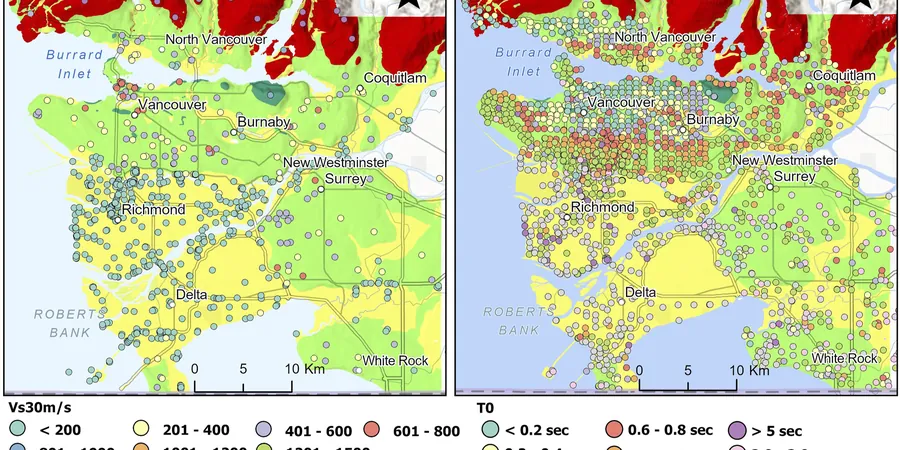
Local considerations
The field setup for a MASW line in Navan starts with a 24-channel seismograph and 4.5 Hz geophones, spaced tight for shallow resolution. We use a sledgehammer source on pavement, and a weight drop on soft ground out by the floodplain. The real risk in skipping microzonation comes from misclassifying the site. If a soft clay lens goes undetected, the design spectrum could underestimate spectral accelerations, leading to under-designed lateral load systems. We've seen borehole logs from the Blackcastle area that show 8 metres of peat under a stiff crust—a profile that will amplify long-period motion significantly. Eurocode 8 Part 1 requires consideration of such local site effects, and the Irish National Annex makes it enforceable for importance class II and above.
Applicable standards
IS EN 1998-1:2005 + Irish National Annex, ASTM D4428/D4428M-07 (MASW), NEHRP Site Classification (Vs30)
Associated technical services
Vs30 Mapping & Site Classification
Grid-based MASW and downhole seismic survey to map shear wave velocity across your Navan site. We deliver EC8-compliant site class maps and Vs30 contour plots.
Ground Response Analysis
1D equivalent-linear (SHAKE) or 2D nonlinear analysis using DEEPSOIL and FLAC. We model the effect of deep limestone bedrock and overlying glacial deposits on surface motion.
Liquefaction Hazard Maps
Assessment of alluvial and river terrace deposits near the Boyne for cyclic resistance. Maps show factor of safety contours for SPT-based and Vs-based triggering methods.
Typical parameters
Frequently asked questions
What is seismic microzonation and why does Navan need it?
Seismic microzonation divides a town or site into zones based on expected ground motion, considering local soil and rock conditions. In Navan, the mix of limestone bedrock, glacial till, and alluvial deposits along the Boyne and Blackwater rivers means ground shaking can vary significantly over short distances. Eurocode 8 requires accounting for these site effects in structural design for importance class II, III, and IV buildings.
How much does a seismic microzonation study cost in Navan?
For a typical commercial or industrial site in Navan, a microzonation study including MASW, ground response analysis, and a compliant report ranges from €3,700 to €14,500. The cost depends on the size of the area, the number of measurement points, and whether 2D analysis is required. A small residential site might fall at the lower end, while a multi-hectare development with complex deep deposits would be at the upper end.
How long does a microzonation campaign take from fieldwork to report?
Fieldwork for a standard site in Navan takes 2 to 3 days for MASW and downhole seismic data collection. Processing, 1D ground response modelling, and report writing add another 2 to 3 weeks. If 2D basin effect modelling or cyclic lab testing of samples is required, the timeline extends to 4–5 weeks. We coordinate directly with local drilling crews to avoid delays.