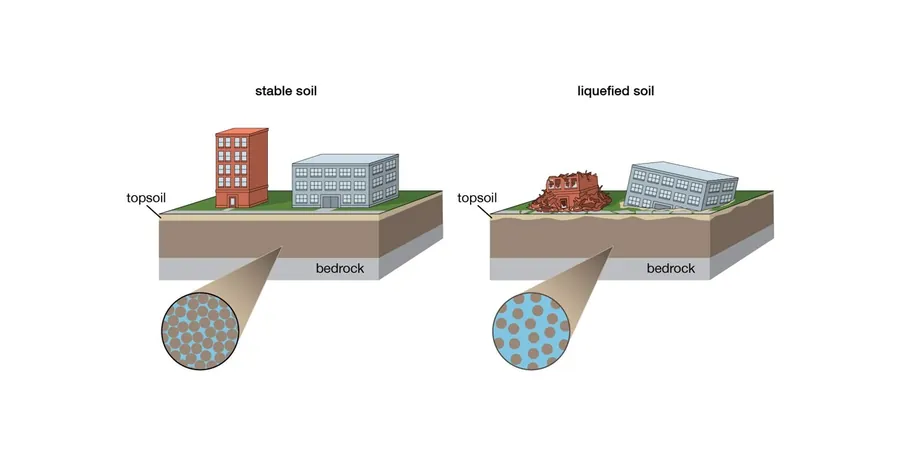
Navan sits on a bedrock of Carboniferous limestone overlain by glacial tills and pockets of alluvial sand and gravel along the Boyne and Blackwater river corridors. The 53.6531°N latitude places it in a region of low to moderate seismicity under Eurocode 8, but the loose, saturated fluvial deposits near the riverbanks can still trigger soil liquefaction during a seismic event. Developers pushing into the old floodplain near the town centre or out by the IDA Business Park need to know whether the ground will hold or lose strength under cyclic loading. A soil liquefaction analysis maps that risk before the first excavator arrives. It's not about scaremongering — it's about quantifying the factor of safety so foundation design doesn't become a gamble. For tight urban sites where a CPT test can profile the subsurface without disturbing the sample, we often pair it with lab-based cyclic triaxial checks to confirm the in-situ behaviour.
Liquefaction isn't just a coastal problem — the Boyne's old floodplain channels in Navan hold loose saturated sands that can turn to slurry under seismic loading.
Methodology and scope
Local considerations
Two sites a kilometre apart in Navan can present completely different liquefaction profiles. The compact glacial till that underlies much of the town centre and the Johnstown area is generally non-liquefiable — its overconsolidated matrix resists pore-pressure build-up. But shift a project out toward the Blackwater Business Park or any brownfield site along the canal, and you're suddenly dealing with Holocene alluvium: loose, normally consolidated, and fully saturated for much of the year. In those conditions, even a magnitude 4.5 event in the Irish Sea could trigger cyclic liquefaction below a shallow footing. The risk isn't theoretical. A 2013 study by the Geological Survey of Ireland mapped soft sediment corridors through the Boyne catchment that overlap with Navan's development fringe. Skipping the soil liquefaction analysis there means accepting an unknown probability of differential settlement, lateral spreading, and structural cracking — liabilities that are far cheaper to engineer out than to litigate later. When the seismic microzonation data flags a borderline LPI, we can model whether stone columns or densification will bring the factor of safety above 1.25.
Applicable standards
IS EN 1998-1:2005 + Irish National Annex (Eurocode 8 – seismic design), IS EN 1997-2:2007 + Irish National Annex (Eurocode 7 – ground investigation), NCEER/Youd-Idriss 2001 (SPT-based liquefaction triggering), ASTM D1586-18 (Standard Penetration Test), ASTM D4428/D4428M-14 (Crosshole seismic – Vs measurement)
Associated technical services
SPT-Based Liquefaction Triggering Analysis
Boreholes drilled to 20 m with SPT every 1.5 m, corrected for overburden and energy ratio (N₁₆₀), processed through the Youd-Idriss simplified procedure to deliver factor of safety and LPI per layer.
CPTu and Seismic Dilatometer Profiling
Piezocone penetration testing with pore-pressure dissipation and Vs measurement for continuous liquefaction profiling. Ideal where thin silt seams control the risk and SPT spacing would miss them.
Cyclic Triaxial and Post-Liquefaction Settlement
Undisturbed sampling of critical layers followed by cyclic triaxial testing (ASTM D5311) to determine CRR directly. Settlement estimates calculated per Tokimatsu-Seed and Ishihara methodologies for the design team.
Typical parameters
Frequently asked questions
What does a soil liquefaction analysis in Navan typically cost?
For a standard residential or light commercial site in Navan, a combined field and lab liquefaction assessment generally runs between €2.440 and €4.030, depending on borehole depth, number of SPT/CPT locations, and whether cyclic triaxial testing is required on undisturbed samples.
Is Navan in a high-seismicity zone?
No, Navan is classified as low seismicity under IS EN 1998-1. However, the presence of loose saturated alluvium along the Boyne and its tributaries means that even moderate ground shaking can induce liquefaction, so the geotechnical risk is governed by soil conditions rather than seismicity alone.
How deep do you need to drill for a liquefaction study?
We typically drill to 20 metres or to bedrock refusal, whichever is shallower, because liquefaction in Navan's alluvial corridors is most critical in the upper 15 metres where overburden confining stress is low and groundwater is near the surface.
Which standard governs liquefaction analysis in Ireland?
The primary framework is Eurocode 8 (IS EN 1998-1:2005) with the Irish National Annex, while the detailed triggering analysis follows the NCEER/Youd-Idriss 2001 consensus procedure, which remains the global reference for SPT-based liquefaction assessment.
Can you test for liquefaction on a small residential extension site?
Yes. Even for single-house extensions near the Boyne floodplain, a targeted CPT or SPT campaign with limited laboratory testing can provide the factor of safety and settlement estimates that a certifying engineer needs for compliance with Building Regulations.