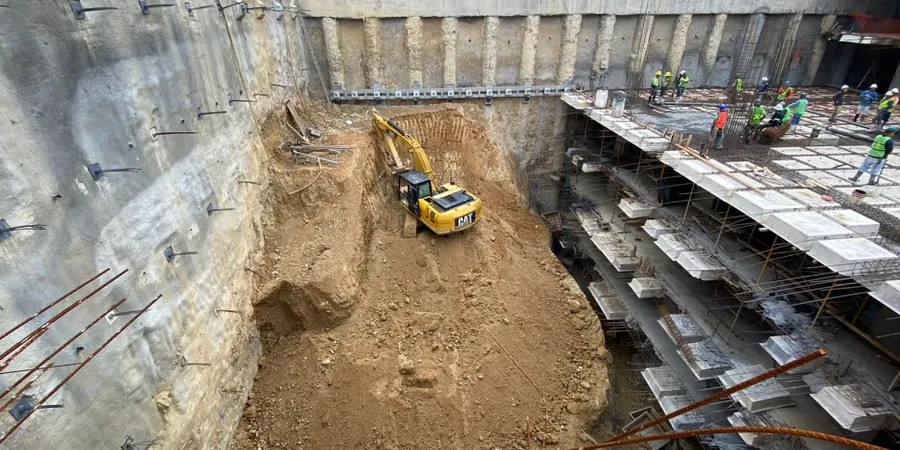
One of the costliest mistakes a contractor can make in Navan is treating a deep dig like a shallow trench. When the site sits on karstified limestone with groundwater moving through solution channels at 3 to 5 metres depth, standard trench boxes simply will not hold. We have seen projects lose weeks to flooding and face collapse simply because the temporary works design never accounted for the real ground profile. A geotechnical design of deep excavations that starts with site-specific ground investigation — not a desk-study assumption — changes the entire risk equation. It turns the shoring, the dewatering, and the sequencing from guesswork into a calculated system. For sites near the Boyne or along the Ratholdren Road corridor, combining that early design with a CPT test provides the continuous soil behaviour profile needed to model wall deflections before a single bucket hits the ground.
A deep excavation in Navan limestone succeeds or fails based on the groundwater assumptions made in the first 48 hours of design.
Methodology and scope
Local considerations
CIRIA C760 and BS EN 1997-1:2004 with the Irish National Annex set a clear expectation: the design of deep excavations must explicitly address groundwater control and the risk of hydraulic uplift. In Navan, this is not a theoretical exercise. The limestone aquifer is unconfined and responds rapidly to rainfall, with observed rises of over 1.5 metres within 48 hours of heavy precipitation. A design that relies on passive sump pumping alone exposes the excavation base to piping and softening of the bearing stratum. We specify cut-off walls keyed into competent rock combined with active dewatering wells sized from packer test data. Basal stability checks incorporate the weight of the low-permeability till where it exists, and we never assume full base plug continuity across a site without probe drilling. The goal is a design that keeps the excavation dry, the sides stable, and the neighbours' foundations undisturbed.
Applicable standards
BS EN 1997-1:2004 (Eurocode 7) with Irish National Annex, CIRIA C760 – Guidance on embedded retaining wall design, BS EN 1993-5:2007 – Steel piling, IS EN 1992-1-1:2004 – Concrete structures
Associated technical services
Temporary Works Design for Basements and Shafts
Full structural and geotechnical design of embedded retaining walls, walers, struts, and tie-back anchors for excavations up to 12 metres depth. Includes staged excavation analysis, dewatering design, and instrumentation specification. Deliverables are signed off by a Chartered Engineer experienced in Irish ground conditions.
Ground Movement and Third-Party Impact Assessment
Finite element modelling of settlement troughs and lateral displacements induced by deep excavation. We assess the risk to adjacent roads, utilities, and buildings using the limiting tensile strain method (Burland) and set trigger levels for observational method implementation.
Typical parameters
Frequently asked questions
What ground investigation data do you need before starting a deep excavation design in Navan?
We require at minimum: borehole logs with SPT N-values to rockhead, rotary core recovery and RQD through the limestone, packer permeability tests at multiple levels within the bedrock, and standpipe piezometer readings over at least one wet season. Lab testing should include undrained triaxial on the till and unconfined compressive strength on the rock core. Without this dataset, the groundwater assumptions and rockhead profile remain too uncertain for code-compliant design.
How do you handle the risk of karst features during excavation?
The design includes a probe drilling programme ahead of piling or diaphragm wall construction to detect cavities larger than 0.3 metres. If a feature is found, we modify the wall toe level to seal into competent rock below the void, or design a grout plug using low-mobility mixes placed under pressure. The observational method is written into the construction sequence so that the response to karst is pre-planned, not improvised.
What does deep excavation design cost for a site in Navan?
For a typical single-basement excavation in Navan, the design fee ranges from €1,810 to €7,680 depending on excavation depth, proximity to neighbouring structures, and the complexity of the groundwater control system. A two-level basement with adjacent roads on Ratholdren Road would sit at the higher end due to the required movement assessments.
Can you design an excavation support system that avoids tie-back anchors?
Yes, where anchors are restricted by adjacent land ownership or utilities, we design cantilever or internally braced systems. In Navan's shallow rock conditions, a secant pile wall socketed into competent limestone often works as a cantilever for depths up to about 3.5 metres. Beyond that, steel struts or raking props are introduced, with the frame designed to clear the permanent works construction sequence.