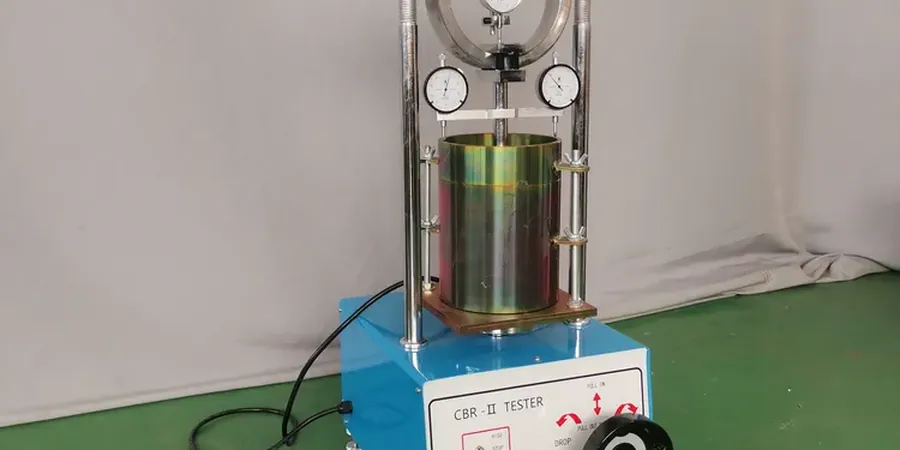
A recent cold storage expansion off the Athboy Road required precise subgrade assessment before the heavy-goods pavement could be designed. The site sat on glacial till derived from the underlying Waulsortian limestone, and the contractor needed a soaked CBR value that reflected Navan's wet winter conditions—average rainfall here hovers around 850 mm annually. Our laboratory team processed remoulded specimens at the optimum moisture content determined by a prior Proctor test, then subjected them to four days of soaking before running the CBR penetration. This sequence, aligned with IS EN 13286-47, gave the design engineer a conservative CBR of 6%, which drove the decision to thicken the capping layer rather than import expensive Type 1 fill. Because Navan sits at the confluence of the Boyne and Blackwater rivers, alluvial pockets appear where you least expect them, and a single CBR value taken at face value without understanding the local drift geology can mislead the entire pavement design.
A soaked CBR value below 5% typically requires either a capping layer or lime stabilisation before pavement construction can proceed.
Methodology and scope
Local considerations
The Boyne valley creates a microclimate where autumn groundwater levels can sit within 600 mm of the surface, and a CBR sample that looks firm in August may lose half its strength after a wet November. We have seen projects around Navan where the subgrade CBR dropped from 8% to 3% simply because the contractor imported fill that had not been tested at the expected post-construction moisture content. The laboratory CBR test addresses this by imposing a four-day soak, but the value still depends on the density and moisture condition at which the specimen was moulded. If the site team fails to protect the formation during wet weather, even a conservative laboratory CBR result won't save the pavement from shear failure under trafficking. For brownfield sites near the old Tara Mines infrastructure, we also run the test on material that has been chemically stabilised, because the calcium-rich binders react differently in Navan's slightly acidic groundwater and the soaked CBR can degrade over time if the binder dosage was calculated without local water-chemistry data.
Applicable standards
IS EN 13286-47:2021 – Unbound and hydraulically bound mixtures – Test method for the determination of California bearing ratio, immediate bearing index and linear swelling, BS 1377-4:1990 – Soils for civil engineering purposes – Part 4: Compaction-related tests, TII CC-SPW-01200 – Specification for unbound and cement-bound mixtures for roadworks (Ireland)
Associated technical services
Soaked CBR with Swell Monitoring
Full IS EN 13286-47 procedure including four-day soak, daily swell readings, and CBR values reported at both 2.5 mm and 5.0 mm penetration. Suitable for subgrade and capping materials.
CBR after Lime-Cement Stabilisation
Specimens prepared with binder admixtures and cured for 7 or 28 days before soaking. The CBR test quantifies the strength gain for stabilised subgrade layers in Navan's moisture-sensitive silty soils.
Pavement Design Input Package
Combined laboratory CBR, Proctor, and particle size distribution results delivered as a single report with a recommended subgrade class for use with TII pavement design charts.
Typical parameters
Frequently asked questions
How much does a laboratory CBR test cost in Navan?
A single-point soaked CBR test in our Navan laboratory typically ranges from €120 to €190, depending on whether the specimen is remoulded at a client-specified density or at the Proctor optimum. The price includes the four-day soak, swell monitoring, and the penetration test with results at both 2.5 mm and 5.0 mm.
What moisture condition should the CBR specimen represent for a Navan site?
We mould specimens at the moisture content and dry density that reflect the expected post-construction condition, not the as-sampled state. For most Navan projects, this means compacting at or near the Proctor optimum and then soaking for 96 hours to simulate a wet winter. If the engineer wants to model a specific groundwater scenario, we can adjust the surcharge and soaking duration accordingly.
Does the laboratory CBR test work for recycled aggregates and crushed concrete?
Yes, IS EN 13286-47 applies equally to natural soils and recycled materials. We modify the compaction effort depending on the aggregate size and apply the same penetration criteria. For crushed concrete with a high pH, we monitor the soaking water chemistry because carbonation can alter the surface of the specimen and affect the measured CBR.
How many CBR specimens should be tested for a residential road in Navan?
The minimum is three specimens per distinct material type encountered on site, but for a typical residential road in Navan we usually recommend five: one from each of the three trial pits at the formation level, plus two on any imported capping material. This gives the pavement designer enough data to calculate a characteristic CBR value rather than relying on a single result.