An embankment for a new access road off the N51 outside Navan showed signs of rutting within weeks of placement, despite the contractor insisting the fill had been compacted to specification. The issue was traced back to guesswork on the moisture content during a rainy fortnight in March. Without a proper Proctor test establishing the specific optimum moisture content for that particular glacial till, the rollers were either pushing water out of the soil or working against a dry, dusty mix that never locked into a dense grain structure. The Proctor test, whether Standard or Modified, defines the maximum dry density (MDD) and optimum moisture content (OMC) that a soil can achieve under a given compactive effort. For projects across Meath, from residential estates in Johnstown to commercial units along the Athboy Road, this laboratory-derived reference curve becomes the benchmark for every field density test on site. We pair it with sand cone density testing during construction to verify that each lift actually meets the specified relative compaction before the next layer goes down.
Compaction without a Proctor reference is just rolling and hoping. The test defines the exact moisture and density window where a specific soil locks into its strongest arrangement.
Methodology and scope
Local considerations
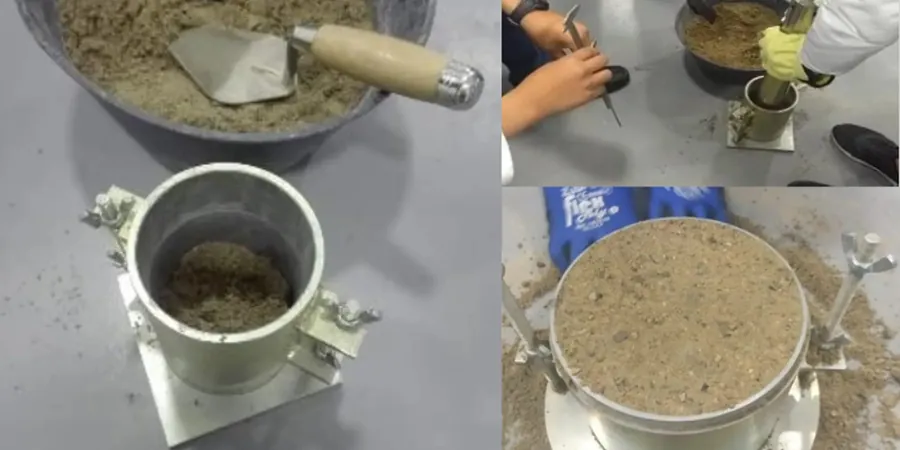
We see projects around Navan where the Proctor is treated as a one-time formality, run on a single bulk sample from the borrow pit and never revisited. That approach collapses the moment the pit face exposes a different stratum or the contractor switches to an on-site cut material. The cylindrical steel mould and calibrated rammer in the laboratory provide a precise, repeatable compaction curve—but only for the sample actually tested. When site conditions change, the reference must change with them. Skipping this update means field density tests report misleading percentages, and the engineer signs off on fill that might be 5 or 8 percent below the true MDD. Over a 3-metre-high embankment, that deficit accumulates into post-construction settlement that cracks pavement layers and distorts drainage profiles. On trench reinstatements for utilities along the Trim Road or new service connections in the former factory sites near the town centre, we routinely recommend a new Proctor for each distinct material encountered, not just each contract. The cost of the test is negligible compared to the expense of excavating and replacing failed compacted fill after the road is open.
Explanatory video
Applicable standards
IS EN 13286-2: Unbound and hydraulically bound mixtures – Test methods for laboratory dry density and water content – Proctor compaction, BS 1377-4:1990: Soils for civil engineering purposes – Compaction-related tests, TII Specification for Road Works Series 600: Earthworks – referencing Proctor methodology for embankment and capping layer acceptance
Associated technical services
Standard Proctor Test
Applies a compactive effort of 600 kN-m/m³ using a 2.5 kg rammer over three layers. Typically specified for residential building pads, landscaping fills, and low-traffic road subgrades where the design loading is moderate.
Modified Proctor Test
Uses a 4.5 kg rammer and five layers, delivering roughly 2,700 kN-m/m³ of compactive energy. Required for heavy-duty pavements, TII road embankments, and industrial floor slabs where higher density and strength are essential.
Oversize Correction & Material-Specific Curves
For glacial tills containing cobbles retained on the 20 mm or 37.5 mm sieve, we apply ASTM D4718 or BS 1377-2 correction methods to adjust the laboratory MDD, ensuring the site target is realistic for the full-gradation material.
Typical parameters
Frequently asked questions
What does a Proctor test cost in Navan, and how long does it take?
For a Standard or Modified Proctor test on a single sample, the fee ranges from €90 to €170 depending on whether the material requires particle-size reduction or oversize correction. The laboratory work is typically completed within three to four working days after the sample arrives. We can accommodate urgent requests for an additional surcharge when earthworks schedules are at risk.
How many Proctor tests do we need for a typical road or housing project in Meath?
The TII specification for roadworks and most local authority planning conditions in Meath require a new Proctor determination for each distinct material type encountered in cut or borrow. On a site where the glacial till transitions from a sandy silt to a gravelly clay over 200 metres, that means at least two separate tests. We also recommend retesting when the apparent moisture content of the placed fill shifts significantly after prolonged rain or dry weather, because the OMC is specific to the material and cannot be guessed from a previous season's curve.
What is the difference between Standard and Modified Proctor, and which one applies to our project?
The difference is the compactive energy applied in the laboratory. Standard Proctor (2.5 kg rammer, 300 mm drop, three layers) replicates the compaction achievable with older or lighter site rollers and is often used for landscaping fills, service trenches, and low-rise building pads. Modified Proctor (4.5 kg rammer, 450 mm drop, five layers) simulates the higher energy of modern vibratory rollers and is specified for TII road embankments, motorway capping layers, and heavy industrial foundations. The project's earthworks specification will state which method to use; if it is silent, we can advise based on the design traffic loading and the roller fleet available on site.