When working in Navan, loose backfill and natural alluvial sands are a common challenge, especially near the River Boyne where the water table sits just a couple of metres below the surface. Many sites around the town centre and expanding industrial estates present a risk of settlement that standard shallow foundations simply cannot handle. That is where a proper vibrocompaction design makes the difference, transforming loose deposits into a competent bearing layer before construction begins. The process relies on depth vibrators to densify granular material in situ, and the design phase must account for the specific grain-size distribution found in the local glacial and fluvial deposits. Without an accurate grain-size analysis and a reliable CPT test to establish the pre-treatment profile, the compaction grid cannot be optimised effectively.
In Navan's fluvial deposits, a well-designed vibrocompaction grid can increase relative density from less than 40 per cent to over 75 per cent, eliminating the need for deep foundations.
Methodology and scope
Key parameters we define in every Navan project include the target depth, which must penetrate at least 0.5 metres into the underlying competent stratum, the compaction point spacing based on empirical correlations with mean grain size, and the water-flushing pressure needed to overcome the local groundwater regime. Where the natural material proves borderline in terms of fines content, we adjust the design by combining vibrocompaction with complementary techniques such as stone columns to guarantee performance in the silty lenses that occasionally appear in the Boyne alluvium.
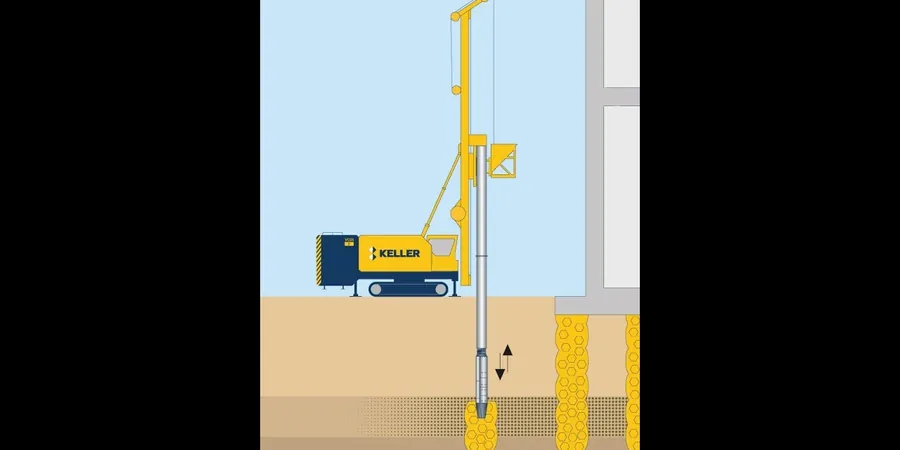
Local considerations
A depth vibrator is not a piece of equipment that tolerates guesswork. When the probe enters the ground on a Navan site, it must overcome the natural resistance of loose sands that can collapse suddenly if the water pressure is not controlled precisely. The main operational risk is a phenomenon called 'arching' — where the sand bridges around the probe instead of flowing and densifying — which we mitigate through real-time monitoring of amperage and hydraulic pressure on the rig. In the Boyne Valley, the proximity of the water table means that excessive flushing can fluidise the soil rather than compact it, so the design must specify conservative flow rates calibrated to the permeability measured in the laboratory. A design that ignores these local hydrogeological conditions can leave the site with undetected loose pockets that will settle differentially once the structure is loaded.
Explanatory video
Applicable standards
Eurocode 7 (EN 1997-1:2004) – Geotechnical design, ASTM D6066-11 – Standard Practice for Determining the Normalized Penetration Resistance of Sands for Evaluation of Liquefaction Potential, ASTM D4253/D4254 – Maximum and Minimum Index Density of Soils, ISO 22476-1 – Cone penetration test (CPT), IS EN 14731:2005 – Execution of special geotechnical works – Ground treatment by deep vibration
Associated technical services
Feasibility and preliminary design
We review the site investigation data, focusing on grain-size curves and CPT logs, to confirm that the Navan soils are treatable and to propose a preliminary grid layout aligned with the structural load requirements.
Detailed compaction specification
The design package includes vibrator type, probe spacing in plan, target depth, withdrawal rate, flushing parameters, and acceptance criteria based on post-treatment CPT cone resistance thresholds.
On-site technical support during execution
Our team provides oversight during the first days of treatment to validate that the design assumptions hold in the ground, adjusting grid spacing or energy input if local variations in the Boyne alluvium demand it.
Verification and reporting
We specify and interpret the post-treatment CPT campaign, comparing before-and-after profiles to document the achieved densification, and compile a compliance report for the building control authority.
Typical parameters
Frequently asked questions
What does a vibrocompaction design package typically cost for a site in Navan?
For most projects in the greater Navan area, the design cost ranges from €1.320 to €4.700 depending on the treated area, the number of compaction points, and the required depth. A small commercial plot under 500 m² would fall toward the lower end, while a larger industrial site requiring extensive pre- and post-treatment CPT verification would approach the upper end of the range.
How do you know if the soil in Navan is suitable for vibrocompaction?
The method works in granular soils with less than about 15 per cent fines passing the 0.075 mm sieve. We make that determination by reviewing the grain-size distribution from borehole samples and CPT data collected on the site. In Navan, the fluvial sands along the Boyne typically meet this criterion, though silty lenses do appear and must be identified early in the design phase.
How long does the vibrocompaction design process take?
Once we have the complete ground investigation data, a preliminary design can be delivered within five to eight working days. The final design, incorporating any adjustments after the treatment trial on site, is usually issued within two weeks of the initial specification.
Can vibrocompaction replace deep foundations in Navan?
In many cases, yes. When the loose sands are treated to a relative density above 70 per cent, the improved ground can support shallow footings or a raft foundation, eliminating the cost and programme impact of piling. The decision depends on the structural loads and the presence of any compressible layers below the treatment depth.
What verification is required after vibrocompaction in County Meath?
The standard approach is to run a series of CPT soundings on a grid of approximately one test per 200 square metres of treated area, comparing the cone resistance before and after treatment. We also recommend at least one zone test where CPTs are performed at the centre of a compaction triangle to confirm the minimum density has been achieved in the critical zone between probes.