Navan grew from a market town at the confluence of the Boyne and Blackwater rivers into a regional hub for manufacturing and logistics. That growth means more deep basements, cut-and-fill car parks, and bridge abutments in tight urban plots. The subsoil here is not forgiving: dense lodgement tills sit over limestone bedrock with a history of karst dissolution. Every retaining wall design in Navan has to account for sudden changes in bearing strata and perched groundwater lenses. We combine site-specific drilling data with limit equilibrium analysis to dimension walls that stay serviceable even when conditions shift during a wet winter. For sites near the river, we often integrate our slope stability assessments to check global failure modes before finalizing the wall section.
A retaining wall in Navan's glacial till is not about concrete volume. It is about embedment ratio, drainage behind the stem, and knowing where the limestone will reject your anchor.
Methodology and scope
Local considerations
A five-storey apartment block on the Trim Road required a 5.2 m retained cut along the site boundary. The initial site investigation identified stiff boulder clay, but the contractor uncovered a dissolution hollow in the limestone during bulk excavation. The hollow was filled with soft organic silt, and the groundwater level was perched 1.8 m above the formation. We redesigned the wall from a cantilever to a propped contiguous pile wall within ten days, integrating a row of temporary ground anchors socketed below the hollow. Had the retaining wall design relied solely on borehole data from the perimeter, the collapse risk would have been real. In Navan, karst features can lurk between boreholes, and wall performance hinges on recognizing that early and adjusting the shoring sequence.
Applicable standards
EN 1997-1:2004 (Eurocode 7), EN 1992-1-1 (Eurocode 2 – concrete), IS EN 14475:2006 (reinforced fill), NRA HD 42/05 (highway retaining structures)
Associated technical services
Cantilever and Counterfort Wall Design
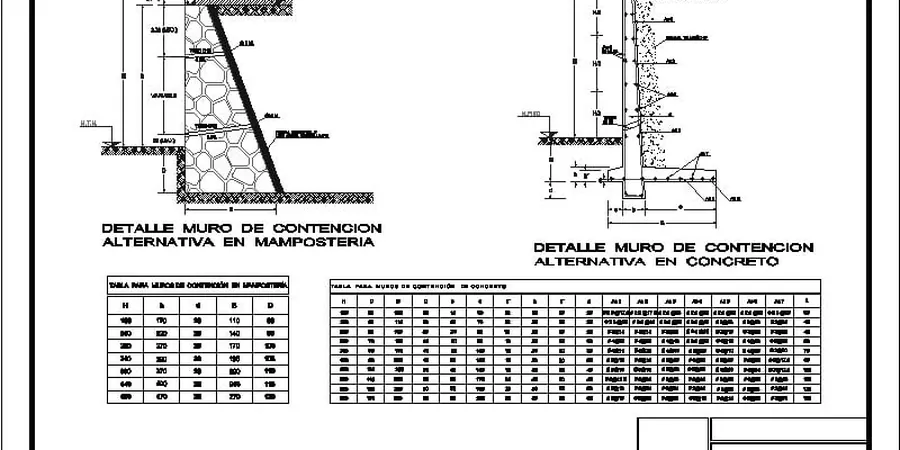
Reinforced concrete stem walls for retained heights up to 6 m. We size the heel, toe, and stem using SLS and ULS combinations per Eurocode 7, with drainage design that accommodates Navan's seasonal groundwater rise.
Embedded Wall Analysis (Berlin-Type)
For basements and cut-and-cover tunnels where space is limited. We model soldier pile and lagging walls in PLAXIS 2D, factoring in the boulder clay stiffness and limestone refusal depth.
Reinforced Soil and MSE Walls
Segmental block and geogrid-reinforced walls for approach ramps and bridge abutments. We specify the reinforcement length, vertical spacing, and select fill gradation to meet NRA durability requirements.
Typical parameters
Frequently asked questions
What does retaining wall design cost for a typical Navan site?
For a standalone cantilever or reinforced soil wall, the design fee ranges between €870 and €3,960, depending on wall height, retained material complexity, and whether anchor design is included. A 3 m garden wall in till sits at the lower end; a 6 m basement wall with karst verification and temporary works design moves toward the upper bound.
Do you handle the planning permission submission for retaining walls in Navan?
We prepare the geotechnical design report and wall drawings to the level required by the local authority. The planning application itself is typically managed by the project architect or planning consultant, but our documentation addresses ground stability, drainage, and neighbour protection – the technical points Meath County Council engineers focus on.
How do you confirm the limestone depth before finalizing the wall section?
We combine rotary open-hole drilling with dynamic probe testing at close centres along the wall alignment. Where the probe meets refusal, we log the rockhead and verify it with at least one cored borehole per 20 m of wall length. This minimizes the risk of missing a karst depression that could undermine the embedment design.