In Navan, in-situ testing provides direct measurement of ground conditions across the limestone-rich Boyne Valley, where glacial tills and alluvial deposits demand verification beyond laboratory analysis. Our methods align with IS EN 1997-2 and the NRA Series 600 specifications, ensuring compliance for local infrastructure. The field density test (sand cone method) remains a staple for earthworks control, offering reliable compaction assessment in granular trench backfill beneath Navan’s expanding commercial estates. These tests reduce uncertainty where karst features and variable drift geology can otherwise compromise foundation design.
Contractors and consultants commission in-situ testing for road realignments, residential developments, and flood relief schemes along the River Blackwater. Beyond density verification, complementary services include plate load testing for bearing capacity and dynamic probing to profile soft alluvial lenses at depth. Early integration of sand cone density data with geophysical surveys streamlines earthworks acceptance, preventing costly over-excavation in Navan’s sensitive brownfield sites. This category equips project teams with the field-validated parameters essential for safe, code-compliant construction on the area’s mixed glacial stratigraphy.
Bond length in Navan limestone is rarely the limiting factor—the real design challenge is the interface between glacial till and karst bedrock.
Methodology and scope
Local considerations
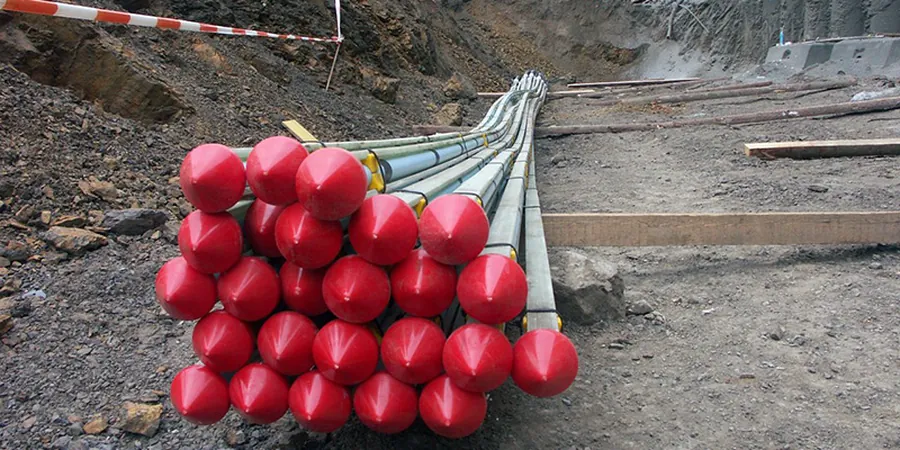
Navan’s bedrock is Carboniferous Waulsortian limestone, extensively karstified over geological time. Borehole records from the GSI database show cavities and softened zones extending to 18 m depth in the town centre area. When a permanent anchor bond zone intersects an undetected karst void, loss of grout confinement can reduce pull-out capacity by 60% or more. The glacial till cover, typically 4 to 9 m thick, contains lenses of laminated silt that exhibit low drained shear strength (φ’ around 26°–28°). Anchor free lengths must pass through these horizons without transferring load to them. We mitigate this with full-length debonding sleeves across the till layer and confirm grout confinement with water pressure testing in the bond zone. For excavations below the water table, the anchor head detail must incorporate a watertight seal to prevent piping along the tendon—a failure mode documented in several Dublin Basin projects. The slope stability of the retained cut during staged excavation is verified with limit equilibrium analysis at each anchor level before tensioning.
Applicable standards
IS EN 1997-1:2004 (Eurocode 7: Geotechnical design – General rules), IS EN 1537:2013 (Execution of special geotechnical works – Ground anchors), IS EN 1992-1-1:2004 (Eurocode 2: Design of concrete structures – anchor head bearing), IS EN 10244-2 (Zinc and zinc alloy coatings on steel wire for tendons)
Associated technical services
Active Anchor Design
Prestressed strand anchors for retaining walls and deep basements. We size the tendon cross-section, calculate bond length in limestone using the effective stress method, and specify lock-off load after friction losses. Full design package with anchor head detail drawing and drainage specification.
Passive Anchor & Rock Bolt Systems
Full-length grouted passive anchors for permanent slope stabilization and rock cut support. Design includes bar diameter selection, corrosion protection category per EN 1537 Annex C, and grout mix design for karstic conditions.
Anchor Testing & Verification
Investigation, suitability, and acceptance testing per IS EN 1537. We run incremental loading cycles up to 1.25 times the design load, monitor creep rate, and interpret residual load from lift-off checks on selected anchors at 7, 28, and 90 days.
Typical parameters
Frequently asked questions
What is the difference between active and passive ground anchors?
Active anchors are prestressed after installation—a hydraulic jack applies a specified lock-off load to the tendon, compressing the retained soil mass before any excavation-induced movement occurs. Passive anchors are grouted full-length without prestressing and develop resistance only as the ground deforms. In Navan projects, we use active anchors where adjacent structures limit allowable displacement to under 10 mm, and passive rock bolts for permanent cut slopes where some deformation is tolerable.
How long does anchor design and testing take for a typical Navan basement excavation?
The design phase runs 10 to 15 working days from receipt of the ground investigation report. Suitability testing on three verification anchors takes 5 to 7 days including curing and incremental loading cycles. Production anchor installation proceeds at 3 to 5 anchors per day depending on limestone drilling conditions. Acceptance testing on working anchors adds one day per batch.
What corrosion protection level is required for permanent anchors in Navan ground conditions?
The mildly aggressive groundwater in Navan’s limestone aquifer, with sulfate levels typically below 200 mg/l and pH between 7.2 and 7.8, allows Class I protection for temporary anchors (service life under 2 years). Permanent anchors require Class II double protection per IS EN 1537—corrugated HDPE duct with factory-grouted annular space around the tendon, plus end cap seals and a watertight anchor head detail.
What is the typical cost range for an anchor design package in Navan?
A complete anchor design package for a retaining wall or basement excavation in Navan, including interpretative geotechnical review, bond length calculations, tendon sizing, corrosion protection specification, and testing schedule, ranges from €1,050 to €3,050 depending on the number of anchor levels and complexity of the retained profile.