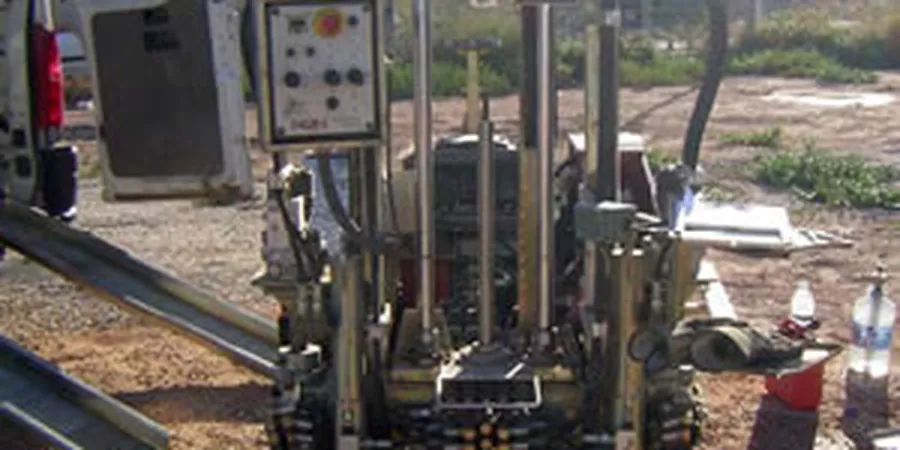
A common mistake we see in the Navan area is relying solely on trial pits or standard penetration tests when the real question is what lies between the boreholes. The glacial tills and limestone-derived clays around the Boyne Valley can change stiffness over less than a metre of depth, and missing a soft lens is precisely how differential settlement starts. Our CPT (Cone Penetration Test) service closes that gap by producing a continuous, high-resolution profile of tip resistance, sleeve friction, and equilibrium pore pressure—without the disturbance that sampling introduces. We deploy a 20-tonne piezocone rig with a 15 cm² cone following ISO 22476-1:2012 procedures, and the data feeds directly into bearing capacity and liquefaction assessments referenced to Eurocode 7 (IS EN 1997-2:2007).
A CPT sounding in Navan’s glacial tills can distinguish a 300 mm soft lens that would be invisible to a standard SPT at 1.5 m intervals.
Methodology and scope
Local considerations
In Navan, the interaction between glacial till and the underlying karstified Carboniferous limestone creates a risk profile that is easy to underestimate. Deep weathering along joint planes can produce narrow, clay-filled dissolution features that act like vertical drains, concentrating groundwater flow and eroding fine material from the till matrix over time. A CPT sounding that shows a sudden loss of sleeve friction combined with a negative pore pressure spike at a specific depth is often the first indicator of a karst cavity or soft raveling zone. We have seen cases where a site near the Blackwater River appeared uniform in borehole logs but the CPT data revealed a 1.2 m drop in tip resistance at 8.5 m—right where the limestone bedrock surface was expected. Without that continuous profile, the foundation design would have assumed competent bearing rock directly above a void, which is a scenario no one wants to discover during excavation.
Applicable standards
IS EN 1997-2:2007 (Eurocode 7 – Ground investigation and testing), ISO 22476-1:2012 (Geotechnical investigation – CPT and CPTU), IS EN ISO 22476-1:2023 (Irish National Annex to CPT procedures), Robertson & Cabal (2015) – Guide to CPT
Associated technical services
Seismic CPT (SCPTU)
Piezocone sounding with a triaxial geophone module at 1 m intervals to measure downhole shear-wave velocity (Vs). Used for site class determination per EN 1998-1 and liquefaction triggering assessments where Navan’s alluvial deposits require small-strain stiffness data.
CPT with Pore Pressure Dissipation
Standard CPTu with dissipation tests at selected depths to measure the time to 50% consolidation (t50). Directly yields coefficient of consolidation (cv) for estimating settlement rates in the low-permeability glacial clays common across Meath.
Correlation and Reporting Package
Full digital log with corrected cone resistance (qt), friction ratio (Rf), pore pressure ratio (Bq), and soil behaviour type classification. Includes bearing capacity estimates for shallow foundations and pile design parameters (unit skin friction, end-bearing) calibrated to local till behaviour.
Typical parameters
Frequently asked questions
How much does a CPT test cost in Navan?
A single CPT sounding in Navan typically falls in the range of €150 to €200, but the total project cost depends on the number of soundings, depth, and whether you add seismic (SCPTU) or dissipation testing. Mobilisation within County Meath is generally straightforward, so we can provide a fixed-price quotation once we know the site location and access conditions.
Can CPT be used in the glacial tills around Navan?
Yes, and it is often the preferred method for profiling the boulder clays and interbedded sands that dominate the area. The 20-tonne rig can penetrate stiff till to depths of 20 to 30 metres provided the gravel fraction is not excessive. If refusal occurs on a large boulder, we typically offset the sounding by 1 to 2 metres and repeat, or supplement with a dynamic probe to confirm the obstruction is isolated rather than continuous bedrock.
What information does a CPT provide that an SPT cannot?
The CPT delivers a near-continuous profile of cone resistance, sleeve friction, and pore pressure—typically at 10 mm intervals—so it captures thin layers, lenses, and gradual transitions that an SPT at 1.5 m spacing will miss entirely. It also measures in-situ pore pressure response during penetration, which is critical for identifying potentially liquefiable silts in the Boyne floodplain and for estimating consolidation characteristics without waiting for laboratory oedometer results. More info.