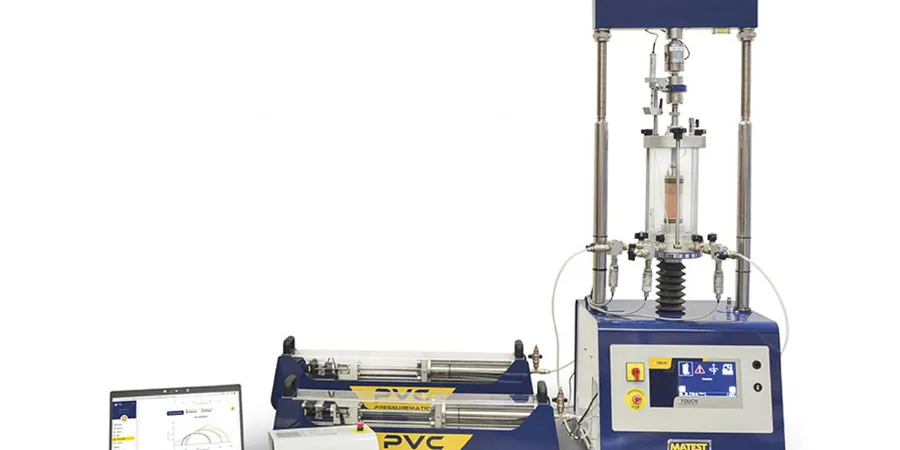
Navan’s variable glacial geology presents a real challenge for foundation design. The Boyne Valley region, with its mix of dense lodgement tills and pockets of softer alluvial deposits, demands precise strength parameters. At 53.65°N latitude, seasonal saturation cycles alter pore pressures significantly. A standard site investigation often misses the effective stress behavior critical for deep excavations or embankment stability. That is where a shear strength evaluation with CPT proves useful alongside advanced laboratory testing. Our triaxial test program measures the undrained shear strength and effective friction angle of these local glacial soils under controlled drainage conditions, providing the numerical backbone for reliable geotechnical models.
Effective friction angles for Navan lodgement till typically range from 32° to 38°, but residual values can drop below 28° after strain softening.
Methodology and scope
Local considerations
Navan town sits at roughly 42 meters above sea level, with the River Boyne and its tributaries cutting through the urban area. Floodplain silts and soft alluvial clays underlie several development zones near the town center. Underestimating the low effective stress strength of these normally consolidated clays leads to bearing capacity failures. A multi-stage CU triaxial test with pore pressure measurement exposes the real undrained shear strength profile. Without it, a designer might overestimate the allowable bearing pressure by 50% or more. For embankments on the floodplain, measuring the rate of consolidation through triaxial permeability tests prevents post-construction settlement disputes. The data also feeds directly into Plaxis or FLAC models for slope stability analysis.
Applicable standards
ISRM Suggested Methods for Triaxial Testing, BS 1377-8:1990, Eurocode 7 (EN 1997-2:2007)
Associated technical services
Multi-Stage Triaxial
A single specimen is sheared at increasing confining pressures to define the failure envelope, reducing sample disturbance effects common in Navan's fissured till.
Stress Path Testing
We replicate field loading conditions — excavation unloading or foundation loading — to measure stiffness degradation directly.
Consolidation Analysis
Coefficient of consolidation (cv) from triaxial drainage data supports settlement predictions for structures on compressible Boyne alluvium.
Typical parameters
Frequently asked questions
What type of triaxial test is most suitable for Navan glacial till?
Consolidated-Undrained (CU) tests with pore pressure measurement are standard. The till's low permeability and fissured structure mean effective stress parameters are essential for design. We saturate specimens to a B-value above 0.95 before shearing.
How much does a triaxial test program cost in Navan?
A typical triaxial testing program for a site investigation in Navan ranges from €1,750 to €2,810 depending on the number of specimens and confining stress stages required. Multi-stage tests on a single specimen can reduce costs.
How long does a consolidated-drained triaxial test take?
A CD test on Navan till can take 7 to 14 days per specimen. Consolidation time depends on sample permeability. We monitor pore pressure dissipation to confirm primary consolidation is complete before the shear stage begins.
Can triaxial tests measure stiffness for settlement calculations?
Yes. We instrument specimens with local strain transducers to measure Young's modulus (E') at very small strains. This data is critical for predicting immediate settlement of footings on the stiff lodgement till.