IS EN 1997-1:2005 (Eurocode 7) requires a properly documented geotechnical design for any ground improvement scheme, and in Navan that requirement hits differently. The town sits on a mix of glacial tills and Carboniferous limestone that has been quietly dissolving for millennia, creating subsurface cavities and highly variable bearing conditions. When a site investigation flags soft alluvial clays or loose silts below the weathered rockhead, vibro stone columns become one of the most practical ways to transfer foundation loads to competent strata. Our team brings field data from SPT drilling and local piezometer records into a design loop that accounts for the real stratigraphy under Navan, not just textbook assumptions. The goal is a column grid that densifies the surrounding soil, drains excess pore pressure, and gives the client a verifiable settlement performance, backed by EN 14731:2005 execution standards.
The real value of a stone column scheme in Navan isn't just bearing—it's the drainage path that kills excess pore pressure before it can cause post-construction settlement.
Methodology and scope
Every design starts with a clear definition of the replacement ratio and the modulus of the composite ground. We run settlement calculations under the working load, checking both the drained and undrained cases, and verify that the stress concentration factor stays within the range validated by Priebe’s method and more recent finite-element benchmarks. The column material itself is specified by particle size and angularity to promote interlock, and we often require a minimum friction angle of 38° for the stone fill. Our laboratory supports this with grain-size analysis and direct shear tests on the proposed aggregate, ensuring the contractor has a tight specification to follow during installation.
Local considerations
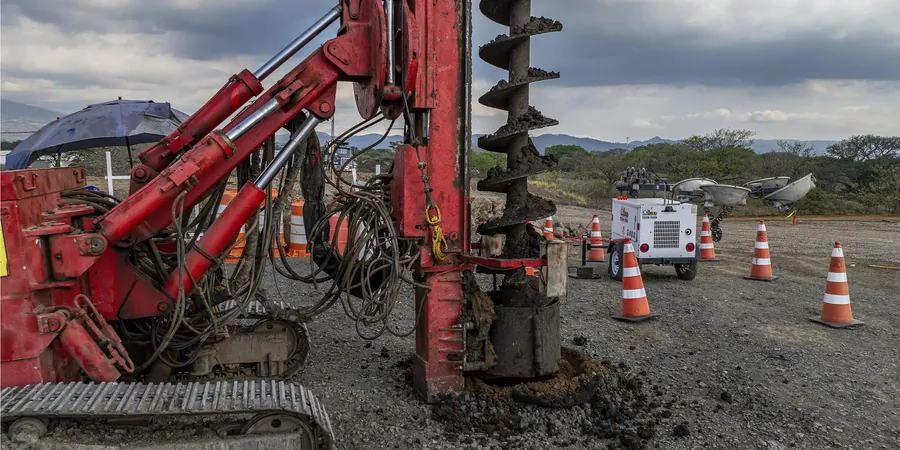
The mistake we see too often around Navan is treating a stone column design as a uniform grid copied from a previous job in Dublin or Dundalk. That shortcut collapses the moment the vibroflot hits a buried karst cavity or an artesian pocket that nobody mapped. The result is either a sudden loss of stone, a column that necks halfway up, or a foundation that settles differentially within the first two years—triggering warranty claims and expensive remedial underpinning. Another recurring problem is ignoring the drainage function: if the stone columns aren’t connected to a horizontal drainage blanket, excess pore pressure builds up in the inter-column soil, effectively canceling the improvement. Our design reports always include a drainage verification clause and a QA/QC protocol that ties column acceptance to post-installation CPT checks, so the contractor knows exactly what “done” looks like before the structural slab goes in.
Applicable standards
IS EN 1997-1:2005 (Geotechnical design – General rules), EN 14731:2005 (Execution of special geotechnical works – Ground treatment by deep vibration), IS EN 1990:2002 (Basis of structural design), ICE Specification for Ground Treatment (2012 edition), IS EN 933-1 (Tests for geometrical properties of aggregates)
Associated technical services
Stone Column Layout and Settlement Analysis
Full design package including replacement ratio selection, Priebe-method settlement estimates, composite shear strength verification, and specification of aggregate gradation. We deliver a column layout plan, depth schedule, and performance criteria ready for the contractor’s method statement.
Post-Installation Verification Testing
On-site CPT and plate load testing to confirm the composite modulus meets the design assumptions. We include a pass/fail protocol tied directly to the settlement limits agreed in the design phase, so there are no gray areas during handover.
Typical parameters
Frequently asked questions
What does stone column design in Navan typically cost?
For a residential or light-commercial site in Navan, a complete stone column design package—covering investigation interpretation, layout, settlement analysis, and post-installation verification—usually falls between €1,260 and €4,750. The spread depends on site size, number of columns, and whether additional CPT or lab testing is needed.
How do you verify that the stone columns work in Navan’s variable ground?
We specify a combination of post-installation CPTs between columns and plate load tests on selected columns. Acceptance is based on the composite modulus, not just column density, which matters a lot in Navan where the inter-column soil can vary from stiff till to soft clay within a few meters.
Which aggregate specification do you use for the stone columns?
We follow EN 14731 and typically specify a clean, angular crushed rock with a nominal size of 25–75 mm, a friction angle of at least 38°, and less than 5 % passing the 63 μm sieve. The exact gradation is confirmed after we test the proposed quarry material in our laboratory.
Can stone columns be used close to existing buildings in Navan town center?
Yes, but the design needs extra care. We often reduce vibration amplitude near sensitive structures and incorporate a staged installation sequence. Pre-construction condition surveys and vibration monitoring are part of the specification we hand to the contractor.