Before breaking ground on any project in Navan, a proper site investigation is not just recommended — it is required under Eurocode 7 (EN 1997-2:2007) and the current Building Regulations Technical Guidance Document A. The Standard Penetration Test (SPT) remains the most widely specified in-situ test across Ireland, and for good reason. Navan sits on a complex mix of Carboniferous limestone bedrock and overlying glacial tills, where bearing capacity can shift dramatically within a single site. A well-executed SPT program gives engineers the N-value data needed to size foundations correctly. When subsurface conditions suggest the glacial deposits are thin or erratic, we often combine the SPT with a seismic refraction survey to map the top of rock across the entire footprint. The SPT is also crucial for assessing the susceptibility of silty sands in the Boyne Valley to settlement under load.
SPT refusal on limestone bedrock in Navan can occur anywhere from 2 to 15 metres — assuming otherwise is the costliest mistake a developer can make.
Methodology and scope
Local considerations
The most common mistake we see in Navan is treating the glacial till as a uniform, competent bearing stratum without SPT verification. Till in the area can contain soft clay pockets or loose sand lenses that go undetected by trial pitting alone. A contractor recently called us after excavating for a pad foundation near the Commons Road — what looked like a stiff brown boulder clay in the pit wall turned out to be a desiccated crust over normally consolidated silt. The SPT N-values dropped from 18 to 4 in less than a metre. That single borehole saved the project from differential settlement that would have cracked the superstructure within two years. Another risk is misidentifying weathered limestone at the rockhead as solid bedrock; the SPT refusal criterion combined with the driller's action logs distinguishes between a boulder, a weathered zone, and competent rock. Without this, pile lengths are guessed, and the cost overrun lands squarely on the owner.
Applicable standards
BS EN ISO 22476-3:2005 — Geotechnical investigation and testing. Field testing. Standard penetration test, Eurocode 7 (EN 1997-2:2007) — Ground investigation and testing, BS 5930:2015+A1:2020 — Code of practice for ground investigations, Irish Building Regulations Technical Guidance Document A — Structure
Associated technical services
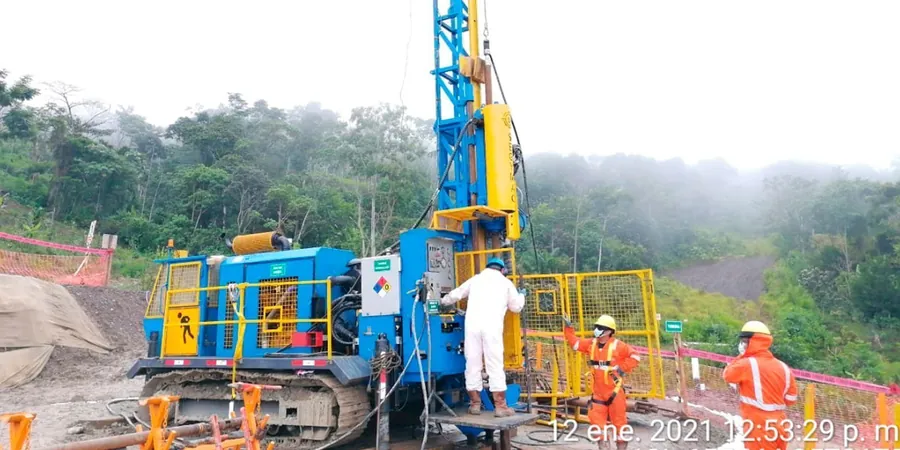
SPT Borehole Drilling & Sampling
Rotary or auger drilling with SPT at 1.5 m intervals or at stratum changes. Disturbed samples logged by an experienced engineering geologist to BS 5930.
Foundation Design Parameter Reports
Interpretative report delivering N60 and N1(60) profiles, drained and undrained strength estimates, and allowable bearing pressure recommendations for shallow and deep foundations.
Combined SPT and Geophysical Surveys
For sites with suspected karst features or irregular rockhead, we pair SPT boreholes with seismic refraction or electrical resistivity to build a continuous ground model.
Typical parameters
Frequently asked questions
How much does an SPT borehole cost in Navan?
For a single borehole with SPT at standard intervals in the Navan area, you are typically looking at €550 to €680, depending on access conditions, depth, and whether you need a tracked rig or a portable unit. A full site investigation with multiple boreholes, groundwater monitoring, and a geotechnical report is priced per project. We provide fixed-cost proposals after reviewing the site location and your engineer's specification.
What depth of SPT testing is typical for a house extension in Navan?
For residential extensions, SPT boreholes usually go to 6–10 metres, or until refusal on bedrock. The exact depth depends on the foundation type and the ground conditions encountered. In Navan, shallow rock means refusal often occurs before 10 metres, but we always confirm with at least one borehole taken 3 metres into competent rock if piles are planned.
Can SPT data be used to assess liquefaction risk in Navan?
Yes, SPT N-values are the most common input for liquefaction assessment using the NCEER/Youd-Idriss method. While Navan is in a low-seismicity region, certain silty sand deposits along the Boyne floodplain can be loose enough to warrant a check if the structure is in Importance Class 2 or 3. We provide N1(60) corrected values and a liquefaction screening report when specified.