Navan’s growth from a Norman market town on the Boyne into a modern regional hub means we’re now building on a patchwork of karstified Waulsortian limestone, glacial tills, and river alluvium that doesn’t give up its permeability secrets easily. Over the past decade, the team has encountered everything from tight clay-rich tills in the Athlumney area to open-jointed bedrock with artesian conditions near the Blackwater confluence, so we’ve learned to never trust a desk estimate when groundwater is involved. A field permeability test gives you direct, site-specific hydraulic conductivity values that borehole logs alone cannot provide, and in Navan’s layered geology that distinction often makes the difference between a dry excavation and a flooded one. When the ground is variable, we often pair the Lefranc test with grain-size analysis to cross-check the in-situ results against the soil’s physical gradation, and in deeper bedrock we rely on the Lugeon method to quantify fracture flow before committing to a grouting programme.
In Navan's karst limestone, a Lugeon test doesn't just measure permeability — it tells you whether your grouting programme will take 10 tonnes of cement or 100.
Methodology and scope
Local considerations
A project we reviewed on the Trim Road side of Navan involved a three-storey apartment block designed with a shallow basement, where the initial site investigation logged only stiff boulder clay and no groundwater strikes in the boreholes. The contractor proceeded with a standard sump-and-pump dewatering plan, but within the first week of excavation they intersected a crushed limestone zone at 4.5 metres that delivered over 15 litres per second into the dig. What should have been a controlled cut became an emergency dewatering operation with four additional pumps and weeks of delay, all because a field permeability test had never been performed in the rockhead transition zone. A single Lugeon stage at that depth would have revealed the high-conductivity fracture set and triggered a redesign of the dewatering system — or a pre-excavation grouting campaign — before a single bucket hit the ground. In Navan’s geology, the cost of skipping in-situ permeability measurement is rarely just a budget line item; it shows up in programme overruns, neighbour complaints, and the kind of site conditions that make insurers nervous.
Applicable standards
BS 5930:2015+A1:2020 Code of practice for ground investigations, ISRM Suggested Methods for rock permeability testing (Lugeon), Eurocode 7 (EN 1997-2:2007) — Ground investigation and testing, BRE Digest 365 — Soakaway design (infiltration testing context)
Associated technical services
Lefranc testing in soils and weathered rock
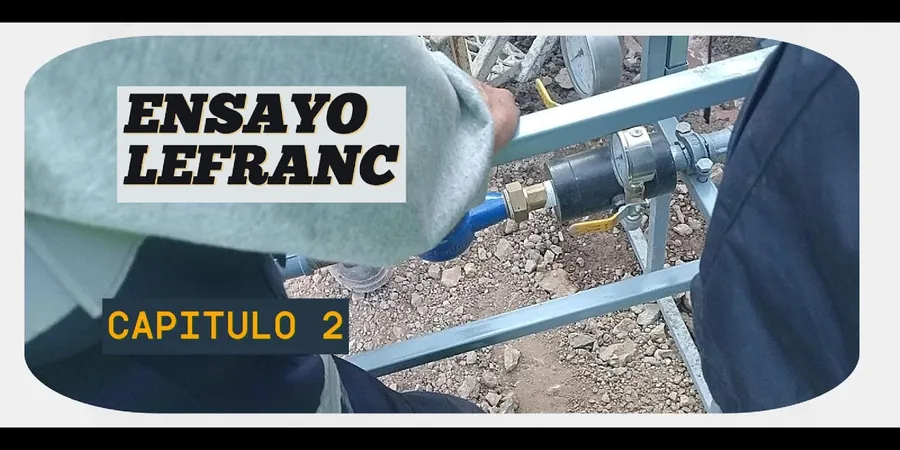
Falling-head or constant-head permeability tests executed within boreholes at target depths, using a screened section isolated from the rest of the hole. We select the test type based on the expected conductivity and monitor recovery with data loggers for accurate curve fitting, which matters in Navan’s silty tills where recovery can be slow and subtle.
Lugeon testing in fractured limestone
Multi-stage packer tests in rock, typically running five pressure steps per stage to distinguish laminar flow from fracture dilation, washout, or clogging. We apply the Houlsby interpretation method as standard and map Lugeon units across the site so the grouting contractor has a clear picture of where the cement is actually going.
Combined permeability and dewatering assessment
A package that integrates field test data with grain-size distributions and groundwater monitoring to produce a dewatering feasibility assessment. For sites near the Boyne or its tributaries, this includes an evaluation of river-aquifer connectivity and recommendations for wellpoint or deep-well system design, backed by numbers the contractor can use for tender pricing.
Typical parameters
Frequently asked questions
What is the difference between a Lefranc test and a Lugeon test?
A Lefranc test measures hydraulic conductivity in soil or highly weathered rock, typically using a short screened section at the base of a borehole with either a falling-head or constant-head procedure. A Lugeon test is designed for rock, using a packer to isolate a section of the borehole and applying water under controlled pressure in multiple stages. In Navan we use Lefranc for the glacial till and alluvial layers, and switch to Lugeon when we hit the Waulsortian limestone to quantify fracture permeability.
How much does a field permeability test cost in Navan?
For a single Lefranc or Lugeon test stage, expect a range between €520 and €960 depending on depth, access conditions, and whether it is combined with an existing drilling programme or requires standalone mobilisation. A full multi-stage Lugeon profile in rock across several boreholes will be at the upper end, while a simple falling-head test in soil during an ongoing investigation tends toward the lower end.
How many test stages do I need for a dewatering design?
There is no fixed number that works for every site, but in Navan’s layered geology we typically recommend at least one test per distinct hydrogeological unit encountered — for example, a Lefranc stage in the upper till, another in the sand-and-gravel layer beneath it, and a Lugeon stage in the underlying limestone. If the site is large or the groundwater gradient steep, we increase the number of stages to capture lateral variability, because a single test can be dangerously misleading in karst terrain.
Can a field permeability test replace laboratory permeability testing?
They serve different purposes and we generally recommend both when groundwater conditions are critical. Laboratory tests on undisturbed samples give you the matrix permeability of the soil, while the field permeability test captures the in-situ mass behaviour including fissures, root holes, and gravel seams that a small sample misses. In Navan’s stony tills, the field value is often an order of magnitude higher than the lab value, so relying solely on lab data would underestimate inflow rates significantly.