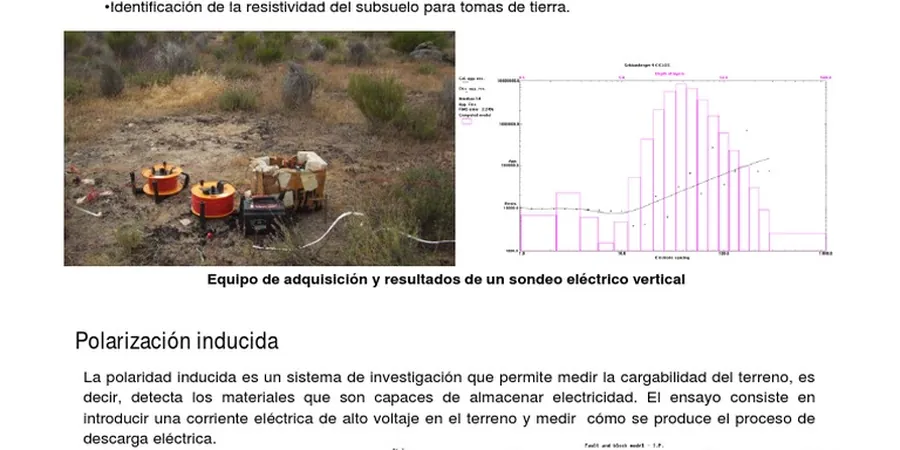
A medium-density housing scheme on the outskirts of Navan, near the banks of the River Boyne, recently required a clear picture of the underlying limestone bedrock before foundation design could proceed. The developer needed to confirm the depth to competent rock and identify any potential karst features that could compromise bearing capacity, but invasive drilling alone would have been too slow and costly for the full site coverage required. Vertical Electrical Sounding delivered the subsurface profile they needed in three days, mapping resistivity contrasts that clearly distinguished overburden from the Waulsortian limestone formation typical of the Navan area. For projects where understanding what lies beneath the surface directly impacts budget and programme, test pits can supplement resistivity data by providing physical samples at key locations, creating a ground model that reduces the risk of unexpected conditions during excavation.
Resistivity contrasts in Navan's limestone terrain can reveal karst cavities before a single bucket hits the ground, turning geophysical data into a direct cost-saving tool for developers.
Methodology and scope
Local considerations
Navan's position within the Irish Midlands means groundwater levels can fluctuate significantly between winter and summer, altering the bulk resistivity of near-surface materials and shifting the apparent resistivity curves that VES interpretation depends on. A sounding performed in August on dry gravels will produce a markedly different response than one taken in February when the same material is fully saturated, which is why our field notes always record recent rainfall and river levels on the Boyne before starting acquisition. Karst limestone terrain introduces a second layer of complexity: dissolution cavities filled with water or clay create resistivity anomalies that can mimic competent rock if the interpreter lacks local geological experience. The worst outcome for any Navan project is a foundation design based on geophysical data that missed a hidden void, and that risk is entirely avoidable when resistivity surveys are cross-checked against borehole logs and interpreted by geophysicists who understand the specific stratigraphy of the Navan Group formations.
Applicable standards
ASTM D6431-18: Standard Guide for Using the Direct Current Resistivity Method, Eurocode 7 (EN 1997-2:2007): Geotechnical design – Ground investigation and testing, IS EN ISO 22475-1:2006: Geotechnical investigation and testing – Sampling methods and groundwater measurements
Associated technical services
Deep VES for Bedrock Profiling
Schlumberger array soundings reaching depths of 80–120 m to map the top of competent limestone beneath glacial drift, critical for large-footprint commercial buildings on Navan's variable overburden.
Groundwater Exploration Surveys
Resistivity profiling and sounding designed to identify water-bearing fractures within the limestone aquifer that supplies many rural properties around Navan, supporting well siting and yield estimation.
Aggregate Deposit Assessment
Wenner array surveys to delineate sand and gravel bodies within glacial outwash deposits, enabling quarry operators and construction material suppliers to quantify reserve volumes economically.
Karst Hazard Detection
High-resolution dipole-dipole profiles across suspect zones to locate dissolution cavities and collapse features before foundation construction, reducing the risk of costly remediation during the build phase.
Typical parameters
Frequently asked questions
How deep can a VES survey investigate in Navan's geology?
With Schlumberger array configurations and sufficient electrode spread, we routinely achieve investigation depths of 80 to 120 metres in Navan's limestone terrain. The practical limit depends on the available space for electrode layout and the resistivity contrast between layers. Glacial till overburden typically allows good current penetration, but highly resistive limestone bedrock can reduce depth penetration if it is shallow and massive.
How much does an electrical resistivity survey cost for a typical site in Navan?
For a standard VES survey with multiple soundings across a residential or light commercial site in Navan, budgets typically range from €520 to €890 depending on the number of sounding locations, depth requirements, and the level of reporting detail. A site-specific quotation is always provided after reviewing the project scope and access conditions.
Can resistivity surveys detect cavities in limestone beneath Navan?
Yes, electrical resistivity is one of the most effective non-invasive methods for detecting air-filled or clay-filled cavities in karst limestone. The resistivity contrast between intact rock and a void is typically strong, though interpretation requires correlation with borehole data to distinguish cavities from other low-resistivity features like water-saturated clay lenses within the Navan Group formations.
What site conditions affect the quality of resistivity data in County Meath?
Several factors influence data quality: buried utilities and reinforced concrete can introduce electrical noise, saturated ground after heavy rain improves current injection but can mask subtle contrasts, and frozen ground in winter makes electrode placement difficult. Our Navan surveys include a pre-field assessment of these conditions and adjustment of array configuration to mitigate interference where possible.