The Boyne Valley isn't just a scenic backdrop—it's a working landscape of deep glacial deposits that directly influence bearing capacity across Navan. Over the last two decades, we've seen how the layered sequence of lodgement till over weathered limestone dictates foundation choice on sites from Athlumney to the IDA Business Park. Getting the grain-size distribution right on these mixed soils is the first practical step: it tells us whether we're dealing with a stiff sandy silt or a more problematic clay-dominant matrix. Most jobs here run into dense till at 1.5 to 2.5 metres—ideal for strip footings—but we never assume uniformity without a borehole log and lab confirmation. The morning frost that lingers in low-lying fields near the Blackwater reminds us that seasonal moisture variation can soften the upper crust, so design bearing pressures must account for a desiccated zone that sometimes extends deeper than the standard 1.0 metre assumed in Dublin projects. We approach every Navan job as a negotiation with the glacial history of the Midlands.
In Navan's glacial landscape, the difference between a straightforward pad footing and a costly over-excavation often comes down to one metre of competent till.
Methodology and scope
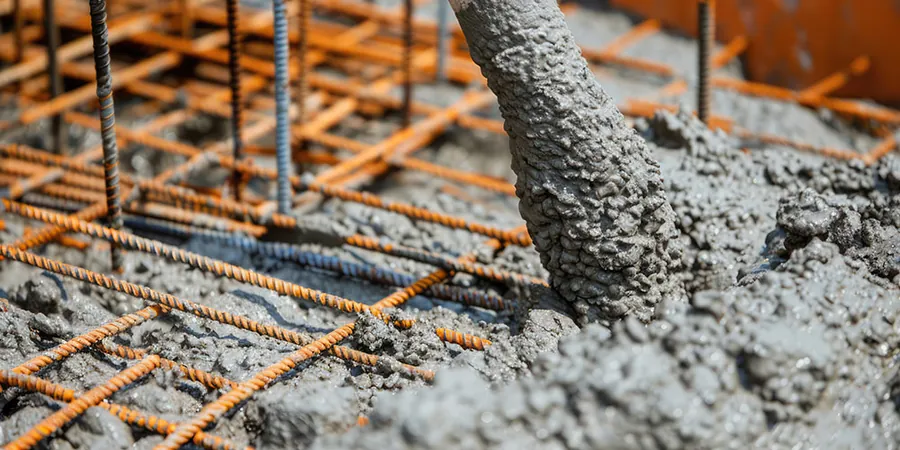
Local considerations
At 42 metres above sea level on the Boyne floodplain, Navan presents a clear risk: the upper metre of soil can be a reworked, softened horizon that looks firm in dry weather but loses strength rapidly when saturated. We've investigated sites after a wet winter where undrained shear strength in the top 800 mm dropped below 40 kPa—a value that simply cannot support a conventional strip footing without either deepening the formation or introducing a granular replacement layer. Solution features in the underlying limestone are another concern; sudden loss of ground into a karst cavity, while rare, demands a probing exercise or geophysical check on larger commercial plots. Differential settlement between cut and fill zones on sloping sites near the river valley sides is something we mitigate by specifying a uniform bearing stratum and avoiding partial foundation support on made ground. The cost of ignoring these local hazards is cracking at the superstructure level within the first two years of occupation.
Applicable standards
Eurocode 7 (EN 1997-1:2004) with Irish National Annex S.I. 9:2014, I.S. EN 1992-1-1:2004 (Concrete design for reinforced footings), BS 8004:2015 (Code of practice for foundations, where EC7 is not prescriptive), BRE Special Digest 1 (Sulfate and aggressive ground assessment, UK/Ireland context)
Associated technical services
Residential Pad and Strip Footing Design
Complete foundation design for single dwellings and housing schemes up to three storeys, including bearing capacity checks, settlement analysis, and reinforcement detailing for strip and pad footings on Navan's glacial tills.
Ground Investigation and Laboratory Testing
Boreholes, trial pits, and laboratory programmes covering particle size distribution, Atterberg limits, and rock strength to characterise the ground model for shallow foundation design.
Construction Phase Monitoring and Certification
On-site inspections during excavation to confirm bearing stratum quality, advise on unforeseen ground conditions, and issue compliance certificates aligned with Building Control requirements.
Typical parameters
Frequently asked questions
What ground conditions are typical for shallow foundations in the Navan area?
Most sites around Navan are underlain by glacial lodgement till—a dense, silty sandy clay with gravel and cobbles—over Carboniferous limestone bedrock. The till is generally stiff and provides good bearing for shallow foundations, but its composition can change over short distances. We always carry out a site-specific investigation to map the depth to rock and check for any softened or wet pockets that could affect footing performance.
How much does a shallow foundation design for a typical house in Navan cost?
For a standard single dwelling on a straightforward till site, our design and site investigation package typically falls between €1.640 and €3.100. The final figure depends on the size of the house, the number of boreholes required, and whether we need additional testing like rock probing or chemical analysis for aggressive ground. We provide a fixed-price proposal after a desk study review of your site.
Do I need a trial pit investigation for a small extension, or is a desk study enough?
A desk study is a useful start, but it can't replace physical investigation for shallow foundation design. Even for a modest extension in Navan, we recommend at least one trial pit to expose the bearing stratum and confirm the soil type visually. Many older properties sit on made ground or backfilled areas, and assuming the ground is natural till without inspection can lead to under-designed footings and future settlement problems.
What depth of foundation is needed to avoid frost damage in County Meath?
The standard minimum embedment we specify for shallow foundations in Navan is 600 mm below finished ground level. This provides adequate protection against frost penetration and also gets the footing below the zone of seasonal moisture fluctuation. On exposed or elevated sites, or where the ground is particularly moisture-sensitive, we may increase this to 750 mm as a prudent measure.